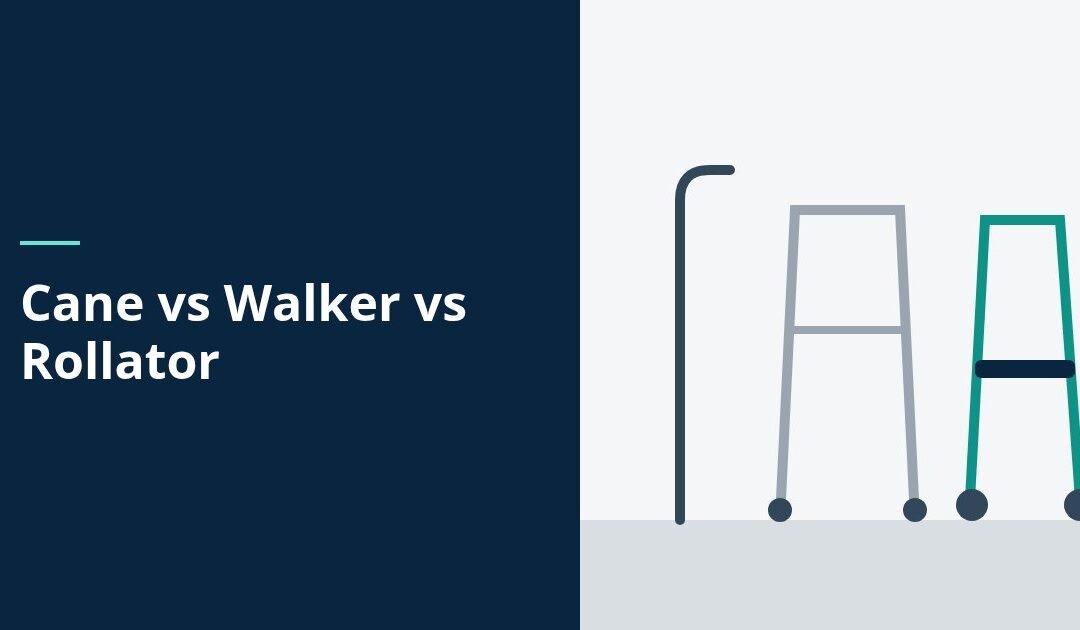
The cane vs walker vs rollator question is really a question about how much of a person's weight goes through their arms and how far they are traveling. A cane gives one extra point of contact with the ground and leaves both legs doing most of the work. A walker is a frame that takes load through four points and is designed to be moved deliberately, a step at a time. A rollator is a wheeled frame with brakes and a seat, built for distance rather than for taking load.
This article is general information about what each type of equipment is built to do and how it is sized. It is not medical advice. Which aid a person should use, whether they should be using one at all, and the exact height it should be set to are decisions for a physical therapist, occupational therapist, doctor or other qualified clinician who has assessed that person in motion. Equipment bought without that assessment is equipment fitted to a guess.
Cane vs walker vs rollator: the short answer
Each of the three sits at a different point on one trade-off. The more contact an aid has with the ground, the more deliberate it is to move. The easier it is to move, the less it does to take load.
- Cane: least load-bearing, most maneuverable, smallest footprint.
- Walker: most load-bearing, least maneuverable, requires lifting or tipping to advance.
- Rollator: rolls continuously, has brakes and a seat, but is not designed to be leaned on heavily as a frame.
The common mistake is reading that list as a progression and assuming a rollator is simply the upgraded walker. It is not. They do different jobs, and a rollator in the hands of someone who needs a walker's load-bearing frame is the wrong tool, because a four-wheeled frame rolls away from a lean.
What a cane is designed for
A cane adds one point of contact with the floor and a handhold. It is used on the opposite side to the leg that needs relief, which is one of several reasons the pattern of use is a clinical instruction rather than something to work out yourself.
The variants differ at the bottom end and the top end:
- Single-point cane: one tip, one contact point. The lightest and narrowest option, and the easiest to carry in a crowded space.
- Quad cane or offset-base cane: a small base with three or four tips. This widens the base of contact with the floor and the cane stands up on its own when let go, at the cost of weight and of needing a flat surface for all tips to land.
- Folding cane: collapses for storage in a bag. Useful when the aid is only needed at one end of a journey.
- Handle shape: a crook handle hooks over an arm; a molded or palm-grip handle spreads pressure across the hand differently. Hand comfort over distance is the deciding factor.
A cane handles a narrow hallway, a crowded store and a car journey without any negotiation. What it does not do is take a substantial share of body weight.
What a walker is designed for
A walker, sometimes called a walking frame, is a rigid frame gripped with both hands. It stands on four legs and is advanced by lifting it or tipping it forward and then stepping into it.
- Standard walker: four rubber-tipped legs, no wheels. The frame is stationary while weight goes through it, which is why it is the most load-bearing of the three. It has to be lifted to advance, which takes arm strength and makes it slow over distance.
- Two-wheeled walker: wheels on the front legs, tips on the back. It is pushed rather than lifted, and the rear tips stop it rolling forward when weight goes onto it. This is the usual middle option.
- Height-adjustable, folding frames: most fold flat for a car trunk, and the legs adjust through push-button holes.
A walker needs a clear floor and a reasonable turning width. In a narrow bathroom, around a tight corner or on a loose rug, it becomes awkward.
What a rollator is designed for
A rollator is a wheeled frame with hand brakes, usually three or four wheels, a seat and often a bag or basket.
The brakes are the defining feature. Squeeze levers slow it; most models also have a park position that locks the wheels for sitting. Because it rolls freely when the brakes are off, it is not a frame to lean into, and it is used by someone who can walk but needs something to hold, somewhere to rest and somewhere to put things.
- Four-wheeled rollator: most stable base and almost always has a seat. Larger footprint.
- Three-wheeled rollator: turns in tighter spaces and is lighter, usually without a seat.
- Wheel size: small hard wheels suit smooth indoor floors; larger wheels handle sidewalk cracks, gravel and thresholds.
The seat is what makes a rollator the distance tool. Being able to sit down at any point changes the length of trip that is workable.
Cane vs walker vs rollator side by side
| Cane | Walker | Rollator | |
|---|---|---|---|
| Points of floor contact | 1 to 4 tips | 4 legs, or 2 legs + 2 wheels | 3 or 4 wheels |
| Load taken through the frame | Least | Most | Limited; frame rolls |
| How it advances | Moved with each step | Lifted or tipped forward | Rolls continuously |
| Brakes | None | None needed | Hand brakes, usually with park lock |
| Seat | No | No | Usually, on four-wheel models |
| Hands occupied | One | Both | Both |
| Turning space needed | Minimal | Moderate to high | Moderate to high |
| Best suited to | Short distances, tight spaces | Deliberate walking with load through the arms | Longer distances with rest stops |
| Carrying things | No | Tray or bag accessory | Basket or bag standard |
How height fitting works
Height is not a comfort preference. An aid set too high or too low changes how the arms and shoulders are positioned over the whole time it is used, so it is part of the clinical fitting rather than something to adjust by feel.
The method commonly used across all three types is the same:
- Wear the shoes that will actually be worn with the aid. Shoe height is part of the measurement.
- Stand upright on a flat floor, arms hanging loose at the sides.
- Find the crease of the wrist.
- Set the handle or handgrip so that it sits level with that wrist crease.
- Check the result at the elbow. With a hand resting on the handle, the elbow should sit at a slight, relaxed bend rather than straight or sharply bent.
- On a walker or rollator, confirm both sides are set to the same hole number, and that every push-button or clamp is fully engaged before any weight goes on it.
Have the fit checked by the therapist or clinician who did the assessment, and have it rechecked if footwear changes substantially. Also check the weight capacity printed on the frame and the handle width, because neither is adjustable after purchase.
Indoor use, outdoor use and your home's layout
Many people end up with two aids, because one device rarely suits both environments.
Measure before buying. Take the clear width of your narrowest doorway, your tightest hallway turn, and the gap between furniture on the routes that get walked daily. Compare those to the overall width of the frame, which is published for walkers and rollators. A rollator that fits the sidewalk and not the bathroom door is a common and expensive discovery.
Then look at the surfaces. Small hard wheels catch on thick carpet and on raised thresholds. Large wheels roll over sidewalk joints and gravel but take up more room indoors. Stairs change the picture entirely, since a frame cannot be taken up a flight, so note whether a second aid or a second handrail is needed at the top.
Finally, note storage and transport. If the aid travels by car, check the folded dimensions and the weight someone has to lift.
Measure your doorways and get the fit confirmed first, then visit the Shop page to compare canes, walkers and rollators by width, weight capacity and height range.